tomorrow is our permanent address ..

... McLuhan claimed some decades ago but nowadays we are simply already immersed and embedded ...
Arthur C. Kroker (editor of ctheory) states that we live in the electronic culture that he (McLuhan) prophesied. And since he wrote about it, technology has become more pervasive, but silent. It’s invisible.
An elder article (written 2005 to remind McLuhan’s actuality 25 year after his death) gives quite a shorter nice overview on McLuhan’s opinions and as well both the enthusiasm and critique his thoughts evoked.

“For the first time, the central nervous system has been `exteriorized,” says Kroker, U Vic’s Canada Research Chair in technology, culture and theory. “It is our plight to be processed through the technological simulacrum… in a `technostructure’ which is nothing but a vast simulation and amplification of the bodily senses.”

McLuhan’s early (1960s) wake-up call about the extent to which people’s very identities are determined by the tools that they themselves invent can be listened to via these two links of the old recordings.

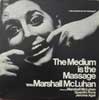
The Medium is the Massage; with Marshall McLuhan.

Long-Playing Record 1968.
Produced by John Simon.
Conceived and co-ordinated by Jerome Agel. Written by Marshall McLuhan, Quentin Fiore, and Jerome Agel.
Columbia CS 9501, CL2701.

again via


UPDATE: read here as well


... between utopias and these quite other sites, these heterotopias, there might be a sort of mixed, joint experience, which would be the mirror. The mirror is, after all, a utopia, since it is a placeless place. In the mirror, I see myself there where I am not, in an unreal, virtual space that opens up behind the surface; I am over there, there where I am not, a sort of shadow that gives my own visibility to myself, that enables me to see myself there where I am absent: such is the utopia of the mirror. But it is also a heterotopia in so far as the mirror does exist in reality, where it exerts a sort of counteraction on the position that I occupy. From the standpoint of the mirror I discover my absence from the place where I am since I see myself over there. Starting from this gaze that is, as it were, directed toward me, from the ground of this virtual space that is on the other side of the glass, I come back toward myself; I begin again to direct my eyes toward myself and to reconstitute myself there where I am. The mirror functions as a heterotopia in this respect: it makes this place that I occupy at the moment when I look at myself in the glass at once absolutely real, connected with all the space that surrounds it, and absolutely unreal, since in order to be perceived it has to pass through this virtual point which is over there. (Heterotopias, M.Foucault, 1967)